
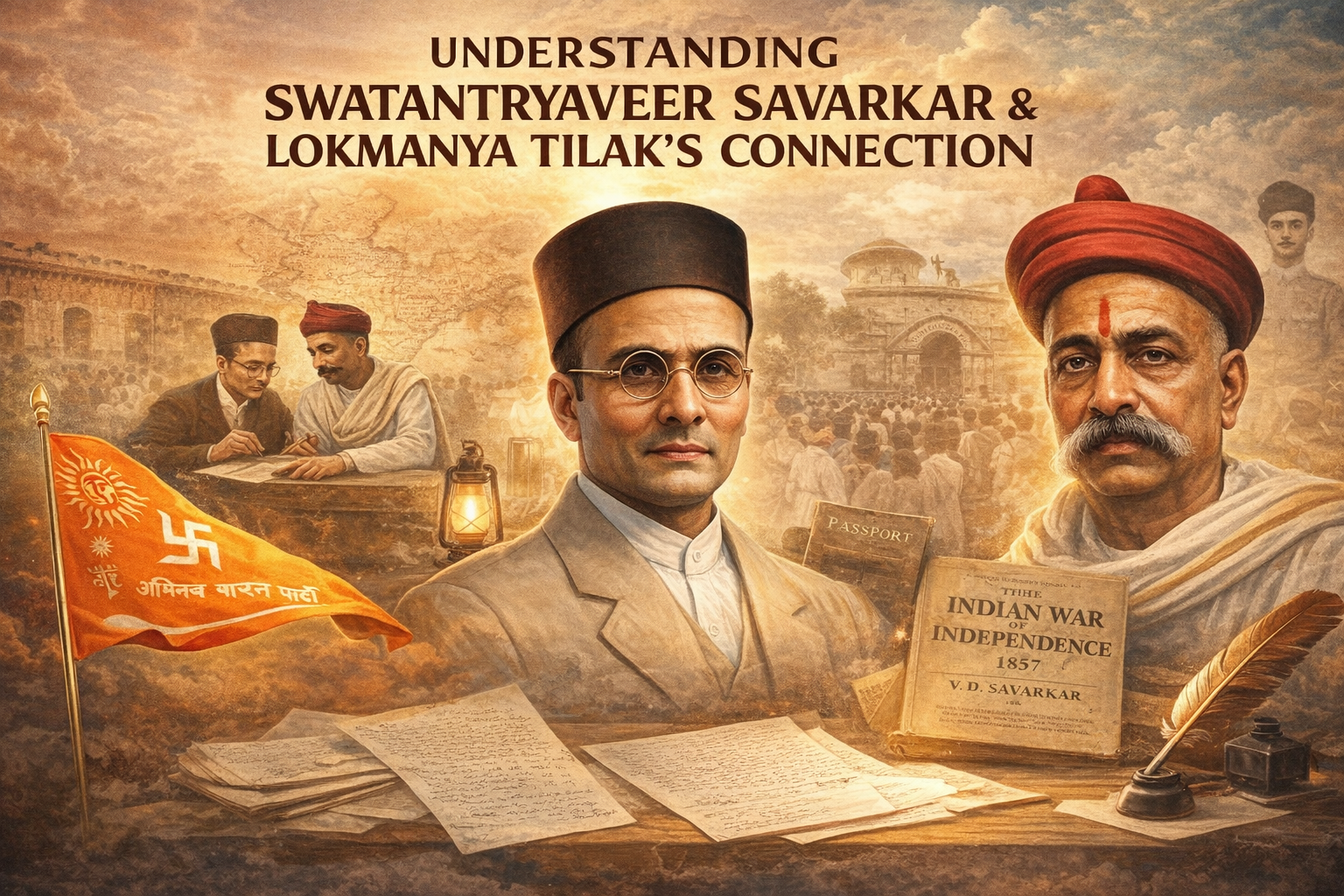
Understanding Swatantryaveer Savarkar and Lokmanya Tilak’s Connection
Exploring the ideological kinship that shaped the Hindutva and Swadeshi Movement in India.
In today’s politically charged landscape, the ideas of Hindutva and cultural nationalism continue to generate discussion. Revisiting the ideological foundations laid by towering figures like Swatantryaveer Savarkar and Lokmanya Bal Gangadhar Tilak is essential to understanding this intellectual tradition. Their relationship was not merely one of admiration, but of shared conviction — to assert India’s cultural identity and political sovereignty.
This article explores their profound connection and the legacy they left behind, particularly in the context of the Swadeshi Movement and the evolution of Hindutva thought.
Lokmanya Tilak: The Forerunner of Cultural Nationalism
Lokmanya Tilak was among the earliest leaders to articulate India as a civilizational Hindu nation. His interpretation of Hindu identity was cultural and historical rather than sectarian. Through public initiatives such as the Ganeshotsav and Shivaji Jayanti, he transformed religious festivals into platforms of political awakening.
Tilak revived pride in India’s past and reconnected the masses with their historical legacy. His writings also criticized Indian elites who aligned themselves with British patronage, questioning their commitment to national interests.
Savarkar’s Early Influence: A Disciple of Tilak
Born in Bhagur and raised in Nashik, Savarkar grew up deeply inspired by Tilak. He regarded Tilak as his “Gurunamguru” — the teacher of teachers. From his early years, Savarkar absorbed Tilak’s assertive nationalism and intellectual rigor.
When Savarkar moved to Pune to study at Fergusson College, Tilak supported him in securing opportunities that eventually enabled him to travel to London. This mentorship strengthened Savarkar’s ideological and revolutionary direction.
The Swadeshi Movement and Anti-British Assertion
The Swadeshi Movement gained momentum in 1905 following the partition of Bengal. Both Tilak and Savarkar actively fueled resistance against colonial economic control.
Savarkar organized the burning of foreign clothes in Pune — a symbolic act representing economic self-reliance and national dignity. Swadeshi became more than a boycott; it was a cultural and political declaration of autonomy.
Tilak’s Revolutionary Temperament
Tilak was often described as a “Yoddha Gruhasthashrami” — a warrior within the framework of civic life. While others emphasized reform within colonial limits, Tilak openly asserted the right to self-rule.
His courage and intellectual boldness left a lasting impression on Savarkar, shaping his belief that national freedom required conviction, organization, and assertive action.
Savarkar in London: Revolutionary in Exile
Arriving in London in 1906, Savarkar studied law but devoted himself to organizing Indian revolutionaries. He authored “The First War of Indian Independence: 1857”, challenging the British portrayal of the uprising as a mere mutiny and presenting it as a coordinated national struggle.
Through literature, speeches, and networking, Savarkar played a key role in mobilizing expatriate Indian nationalism.
Ties That Endured Across Borders
When Tilak was imprisoned in 1908, Savarkar organized protests abroad condemning the action. Their ideological bond transcended geography and prison walls.
Tilak’s support and recommendation letters for Savarkar reflected mutual respect and shared purpose.
Emergence of Hindu Rashtra Thought
During his imprisonment, Savarkar articulated the philosophical foundations of Hindutva and the concept of Hindu Rashtra. His ideas echoed Tilak’s declaration that self-rule was an inherent right.
Savarkar’s framework emphasized cultural unity, historical continuity, and national cohesion.
Debates on Representation and Unity
In the early 20th century, political debates on separate representation intensified divisions. Tilak and Savarkar expressed concerns that communal compartmentalization could weaken national unity.
They advocated equal civic rights while emphasizing cultural solidarity as the foundation of nationhood.
Modern Resonance of Their Ideology
The philosophical influence of Tilak and Savarkar continues to shape discussions around cultural identity, national self-confidence, and sovereignty. Their emphasis on civilizational continuity remains relevant in contemporary discourse.
Conclusion: A Shared Flame of National Awakening
The bond between Swatantryaveer Savarkar and Lokmanya Tilak represents a significant ideological partnership in India’s freedom struggle. Their shared vision helped shape the trajectory of cultural nationalism.
Understanding their connection provides insight into the evolution of nationalist thought and its continued relevance in modern India.
