
The Literary Legacy of Veer Savarkar: A Case for Bharat Ratna
Veer Savarkar as a Literary Giant: Why His Writings Alone Merit the Bharat Ratna
Vinayak Damodar Savarkar—popularly known as Veer Savarkar—is often remembered through the lens of politics and revolution. Yet, beyond ideological debates lies a towering but under-recognized truth: Savarkar was one of modern India’s most powerful literary minds. As a poet, historian, playwright, essayist, and rational thinker, his body of work profoundly shaped India’s intellectual and cultural consciousness.
Judged purely on literary merit, Savarkar stands among the finest writers India has produced—making a compelling case for honoring him with the Bharat Ratna for literature alone.
Why Literary Contributions Deserve the Highest Civilian Honor
The Bharat Ratna has long recognized excellence in public service, science, arts, and social transformation. Literature—when it shapes national identity, awakens collective thought, and influences generations—deserves equal reverence.
Savarkar’s writings did precisely that. Across genres and languages, his work fused history, philosophy, nationalism, humanism, and rational inquiry, creating a literary legacy that transcended its time.
A Prolific and Multidimensional Literary Mind
Savarkar was not confined to a single literary form. His versatility itself sets him apart as a rare intellectual force.
Poetry That Stirred a Nation
His poems such as Saagara Pran Talamala and Jayostute remain deeply emotional expressions of pain, hope, and unyielding patriotism—many written under the brutal conditions of incarceration. These verses continue to resonate for their lyrical beauty and emotional depth.
Historical Writing with National Purpose
Works like The Indian War of Independence 1857 and Six Glorious Epochs reframed Indian history from an indigenous perspective, instilling pride and countering colonial narratives. His historical prose combined rigorous research with compelling storytelling.
Plays, Novels, and Social Commentary
Through plays and novels such as Sanyast Khadga, Mala Kay Tyache, and Moplah Rebellion, Savarkar explored themes of liberty, ethics, social reform, and human agency—using literature as a tool for introspection and transformation.
Biographical and Linguistic Contributions
His biography of Joseph Mazzini, notably the first Marathi book written outside India, reflects his global intellectual outlook. He also pioneered modern Marathi powadas (ballads) and edited revolutionary newsletters in Marathi while abroad—an extraordinary literary achievement for his time.
Themes That Shaped Modern Indian Thought
Savarkar’s literature was never ornamental; it was purposeful. Each theme addressed the challenges of society and the future of the nation.
Cultural Identity and Unity
In Hindutva: Who is a Hindu?, Savarkar articulated a cultural framework that sought unity among diverse Indic traditions, emphasizing shared heritage over sectarian divides.
Freedom, Sacrifice, and the Human Spirit
His prison poetry, written in the Cellular Jail, stands as some of the most moving literature born out of captivity—capturing suffering without surrender and hope without illusion.
Rationalism and Scientific Temper
Savarkar was a fierce critic of superstition and blind tradition. Essays like Machine Is a Boon to Mankind reveal his commitment to modernization, science, and reason—values essential to a progressive society.
Utilitarian Ethics and Social Reform
He evaluated customs through the lens of public good, advocating for pragmatic solutions to issues like malnutrition and social stagnation—an approach far ahead of its time.
Humanism Beyond Nationalism
For Savarkar, nationalism was not an end but a means—leading ultimately to universal human values such as liberty, equality, and dignity.
A Literary Legacy Still Searching for National Recognition
While Savarkar’s songs and poems are revered in Maharashtra, his literary stature has yet to receive commensurate national acknowledgment. This limited recognition contrasts sharply with the depth, range, and enduring relevance of his work.
His writings—born of exile, imprisonment, and relentless intellectual pursuit—continue to inspire readers who encounter them, often for the first time.
Enduring Demand for His Books
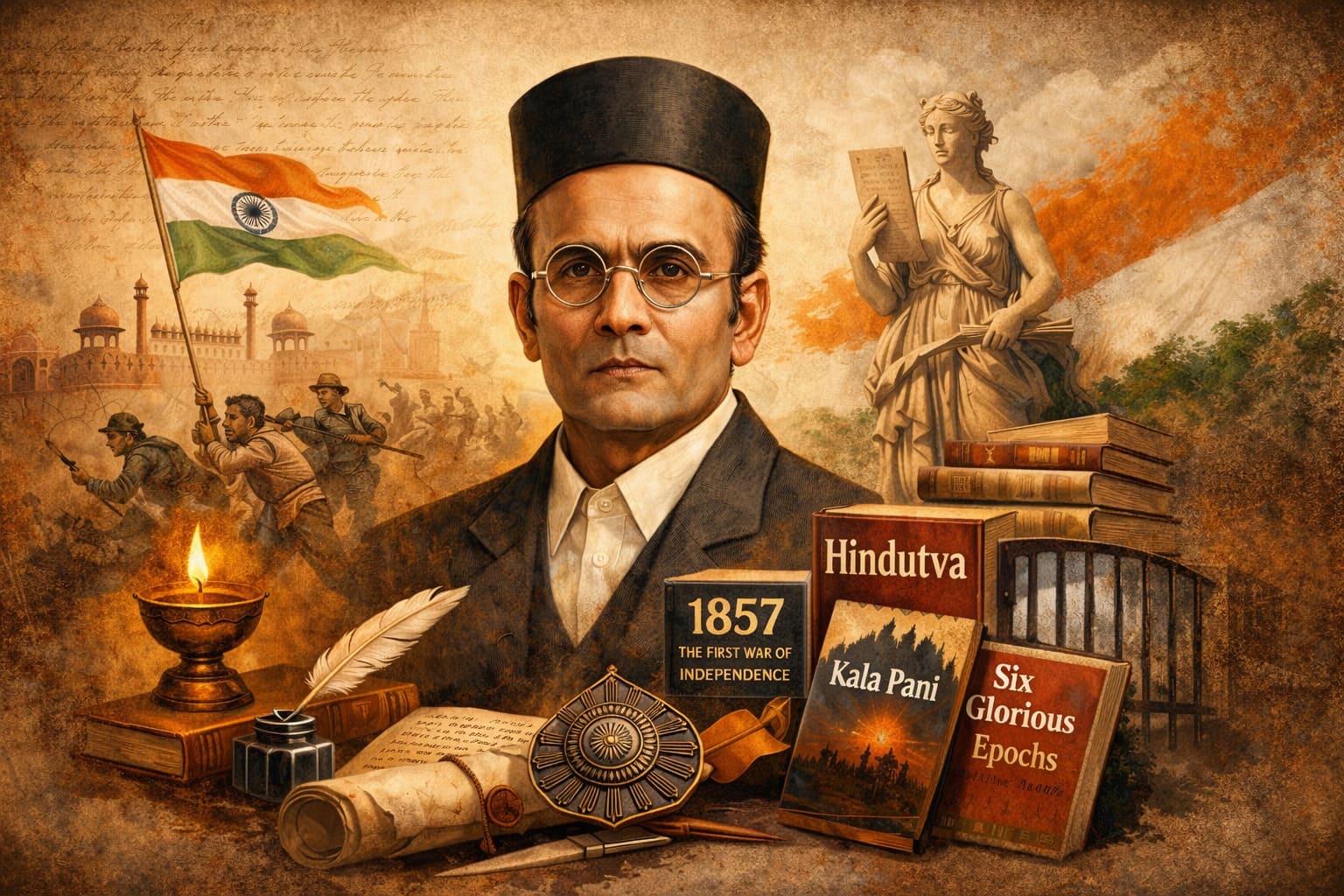
Even today, Savarkar’s major works remain widely sought after, including:
-
Hindutva
-
1857: The First War of Independence
-
Kala Pani
-
My Transportation for Life
-
Six Glorious Epochs
Many of these titles frequently go out of print, reflecting both sustained public interest and insufficient institutional promotion of his literary heritage.
Conclusion – Honoring the Pen That Shaped a Nation
Vinayak Damodar Savarkar’s literature represents a rare synthesis of intellectual rigor and emotional power, historical insight and poetic brilliance, national pride and universal ethics. His vision extended far beyond political freedom—it imagined an India rooted in reason, courage, and human dignity.
Awarding the Bharat Ratna to Savarkar solely for his literary contributions would not be a political statement, but a cultural one. It would affirm that India honors those who shaped its moral and philosophical foundations through the enduring power of words.
Savarkar deserves to be remembered not only as a revolutionary but as a renaissance figure of Indian literature whose pen continues to speak across generations.
